Computational biology
The Computational Biology group addresses biological problems using computational, mathematical and biophysical methods. We want to understand how cellular and molecular systems adapt to their host environments and how they change in evolution.
Our group is interested in how biological systems, such as organisms, tissues, organelles cells or molecular systems, adapt to changing environments, and during development.
Biological systems, such as organisms, organs, cells, organelles or molecular systems, are highly dynamic and change for instance over time during development, during ageing, as well as to cues coming from their environment.
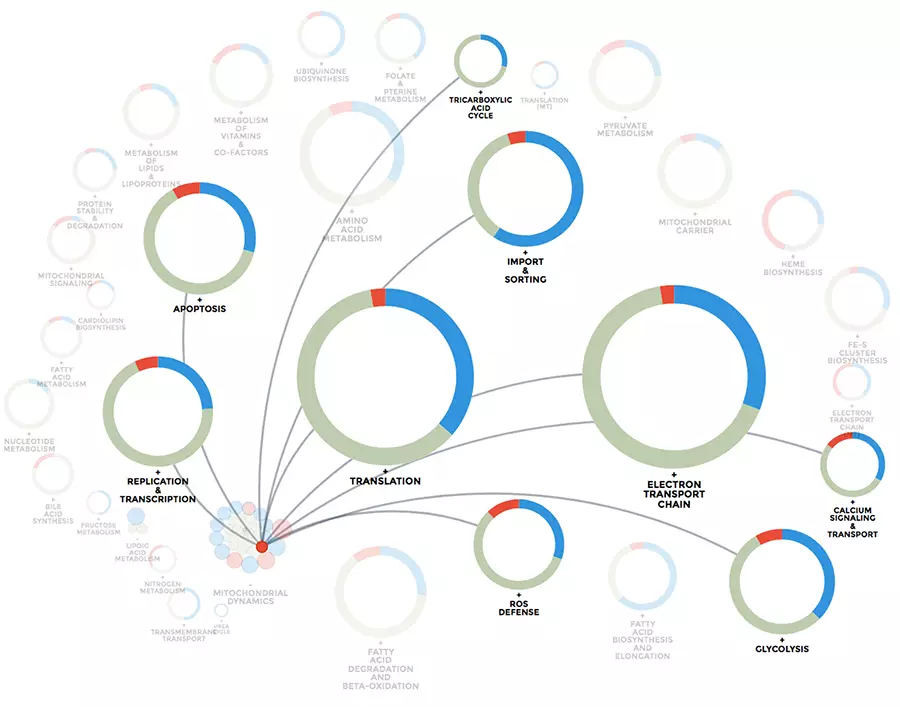
To give one example, mitochondria, which are important bioenergetic and metabolic organelles in eukaryotic cells, mature during development, changing their structure, their content and their metabolism. They also adapt to the cell type they are hosted in and change in disease, adapting their structure, content and metabolic function to the cellular needs in response to multiple molecular, chemical, metabolic, bioenergetic and mechanical cues. What are the underlying mechanisms and signals that drive mitochondrial adaptation?
Such metabolic adaptations to the environment can also be seen in bacteria. In these simpler organisms, we can even study in real time the evolutionary cues that lead to the adaptation to their environment, and to other interacting species, for instance in symbiotic, competitive or predatory relationships.
To ensure integrity of the genome during DNA replication, cells use a complex mechanism of origin of replication selection in eukaryotes, which involves a set of highly complex protein machines together with contextual structural cues of the DNA. The selection of replication origin, while not guided by sequence-specificity in most opisthokonta, is not random. The properties of replication origins can change during cell differentiation and also during disease. What are the underlying mechanisms of replication origin selection?
We address these questions using a set of computational, mathematical, and biophysical methods, which include visual data mining, metabolic modelling, network biology with complex networks and knowledge graphs, evolutionary analysis, as well as cellular automata and biophysical modelling.
Publications
mitoXplorer 3.0, A Web Tool for Exploring Mitochondrial Dynamics in Single-cell RNA-seq Data
MechanoProDB: a web-based database for exploring the mechanical properties of proteins
The mitoXplorer 2.0 update: integrating and interpreting mitochondrial expression dynamics within a cellular context
mitoXplorer 3.0, A Web Tool for Exploring Mitochondrial Dynamics in Single-cell RNA-seq Data
MechanoProDB: a web-based database for exploring the mechanical properties of proteins
The mitoXplorer 2.0 update: integrating and interpreting mitochondrial expression dynamics within a cellular context
RNfuzzyApp: an R shiny RNA-seq data analysis app for visualisation, differential expression analysis, time-series clustering and enrichment analysis_edited
SLALOM, a flexible method for the identification and statistical analysis of overlapping continuous sequence elements in sequence- and time-series data
HH-MOTiF: de novo detection of short linear motifs in proteins by Hidden Markov Model comparisons
Tools for visualization and analysis of molecular networks, pathways, and -omics data.
PsicquicGraph, a BioJS component to visualize molecular interactions from PSICQUIC servers.
News
Embark on a PhD journey at the IBDM
13 PhD projects open at IBDM for the Life Science Doctoral School Contest !
We’re pleased to share some great news about our researchers’ achievements! Several projects from our teams have been selected for funding by the ANR and FRM, highlighting their hard work and innovative research.
Congratulations to Robert Kelly, Frank Schnorrer, Cédric Maurange, Bianca Habermann and Delphine Delacour!
IBDM inspires schoolchildren
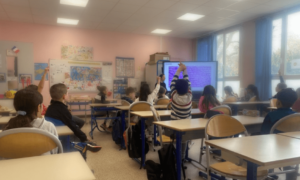
IBDM Marseille inspires young minds: engaging primary school children on childhood cancer (“Contre le cancer, j’apporte ma pierre”) and interacting with high school students through immersive experiences (DECLICS).
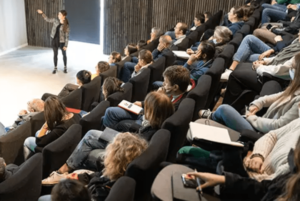
Join us on 29/06/2023 at 12:30 in Amphi 12 for an exciting talk by Rikesh Jain and Theo Brunet from our Team!
5 motivated and talented students successfully defended their thesis between September 2022 and January 2023.
Show me your rhythm!
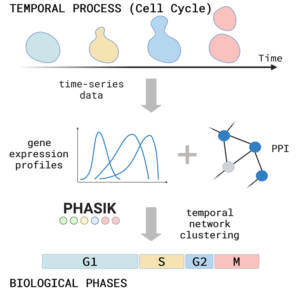
We introduce an algorithm, Phasik, for extracting the phases of biological systems by clustering partial temporal networks.
Self-organisation of human muscles in a dish
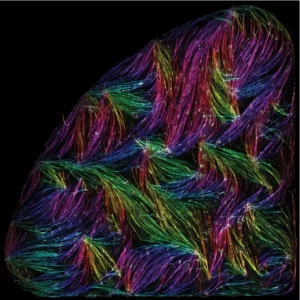
Human muscle cells self-organise into defined fiber bundles in vitro even without the presence of external cues !
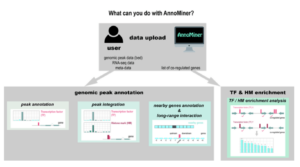
We introduce a novel, user-friendly web-based tool ‘AnnoMiner’ to annotate and integrate epigenetic and transcription factor binding data.
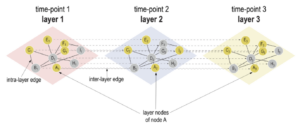
Look at the TIME in your interaction network
The Habermann team has repurposed the concept of multilayer networks generally used to integrate different types of data.
Ph.D. Student in Biology (M/F)
Missions :Myomedusa: How Did Muscles Evolve?As part of this project, we aim to trace the evolutionary history of our striated muscle. To answer this question,
Embark on a PhD journey at the IBDM
13 PhD projects open at IBDM for the Life Science Doctoral School Contest ! Students interested in pursuing a PhD in developmental biology, cell biology,
2 ANR-funded PhD Positions | MYOMEDUSA: Structure, Development and Evolution of Medusa Myofibrils
The Schnorrer and Habermann teams in Marseille are welcoming applications for two ANR-funded PhD positions to decipher the structure, development and evolution of jellyfish muscles, in collaboration with the Cnidevo/Leclère team from the Oceanographic Observatory of Banyuls-sur-Mer.
Our team at the IBDM is part of a Maitre de Conference competition for a permanent assistant professor position in Bioinformatics in Aix-Marseille University.
Team members
Alumni
Funding bodies