Team members
Muscle dynamics
We are investigating the mechanobiology of muscle. We are interested in how functional muscles are made during development and how they remain functional through the lifespan of an animal.
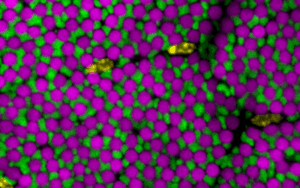
The strength of our group lies in its unique combination of systematic genetics and live in vivo cell biology, with mechano- and structural biology. We are using Drosophila in vivo and human iPSC in vitro models to study the mechanisms how muscle assemble their contractile sarcomeres and how these sarcomeres are serviced in the living animal to remain functional throughout life. Sarcomeres are amongst the largest protein assemblies in animals: they produce high forces and mechanically link to the skeleton to power animal movement. Hence, sarcomeres are a fantastic playground to understand basic principles of biology:
How do thousands of large proteins assemble to build a micro-meter large pseudo-crystalline sarcomere?
How do thousands of sarcomeres self-assemble to chains that mechanically connect across centi-meter long muscle fibers?
How are sarcomere development and maintenance coordinated with the other physiological requirements of muscle cells including mitochondria biogenesis, T-tubule formation and proteasomal turn-over of damaged proteins throughout life?
Answering these questions will enable us to better understand how muscle are effectively built during development, how they adapt to their different physiological needs (see heart vs. skeletal muscles) and how they remain functional for our entire life.
Publications
Titin-dependent biomechanical feedback tailors sarcomeres to specialized muscle functions in insects
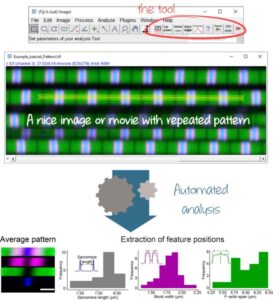
PatternJ: an ImageJ toolset for the automated and quantitative analysis of regular spatial patterns found in sarcomeres, axons, somites, and more
Gene Tagging Strategies To Assess Protein Expression, Localization, and Function in Drosophila.
Mechanical tension and spontaneous muscle twitching precede the formation of cross-striated muscle in vivo.
Tension and force-resistant attachment are essential for myofibrillogenesis in Drosophila flight muscle
Transcriptional regulation and alternative splicing cooperate in muscle fiber-type specification in flies and mammals
In vivo RNAi rescue in Drosophila melanogaster with genomic transgenes from Drosophila pseudoobscura
The transmembrane protein Kon-tiki couples to Dgrip to mediate myotube targeting in Drosophila
The molecular motor dynein is involved in targeting swallow and bicoid RNA to the anterior pole of Drosophila oocytes.
News
Microtubules: The Architect of Muscles
Sarcomeres: look, they divide
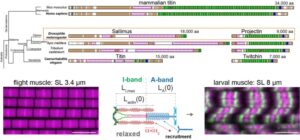
Genetics, in vivo imaging and force measurements combined with
mathematical modelling reveal how titin tailors sarcomere specialisations in
Drosophila.
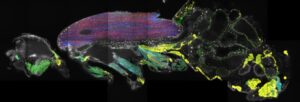
Spatial transcriptomics of adult Drosophila
Single-molecule mRNA detection method reveals brain cell types and mRNA localisation patterns in muscle cells of adult Drosophila.
We’re pleased to share some great news about our researchers’ achievements! Several projects from our teams have been selected for funding by the ANR and FRM, highlighting their hard work and innovative research.
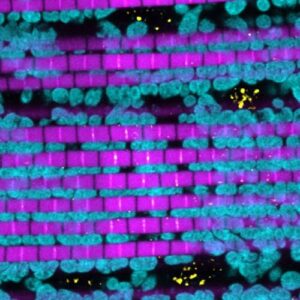
Muscle development under pressure
The transcriptional regulator Tono coordinates myogenesis in Drosophila by sensing pressure build-up in muscle nuclei.
Join the IBDM for your internship!
Seeking for your Master internship? The IBDM seems like the right place to do it? Check out our offers.
Congratulations to Robert Kelly, Frank Schnorrer, Cédric Maurange, Bianca Habermann and Delphine Delacour!
From AFM-Téléthon Postdoc Fellow to CNRS Researcher: Qiyan Mao is advancing human muscle research through molecular and tissue mechanics approaches.

IBDM Marseille inspires young minds: engaging primary school children on childhood cancer (“Contre le cancer, j’apporte ma pierre”) and interacting with high school students through immersive experiences (DECLICS).

Internal Seminar by Nuno Luis
Join us on 13/07/2023 at 12:30 in Amphi 12 for an exciting talk by Nuno Luis from our Team! Delphine DaugaBiocurator at Bioself
Drosophila sarcomeres visualised at super-resolution with the help of nanobodies and single molecule blinks.
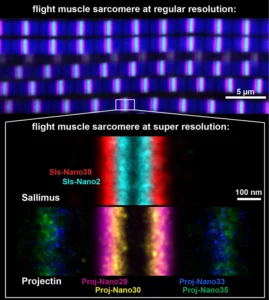
Organizing the organizers
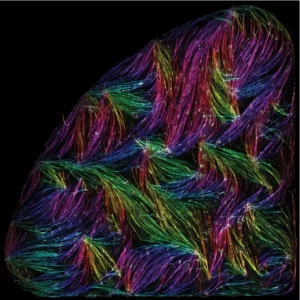
Self-organisation of human muscles in a dish
Human muscle cells self-organise into defined fiber bundles in vitro even without the presence of external cues !
Frank Schnorrer elected as EMBO member
EMBO elects 67 new members and associate members. They join the community of more than 1,900 leading life scientists in Europe and beyond.
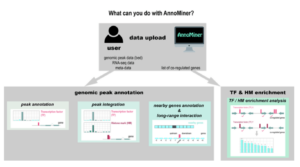
We introduce a novel, user-friendly web-based tool ‘AnnoMiner’ to annotate and integrate epigenetic and transcription factor binding data.
By combining genetics in the fruit fly Drosophila with state-of-the-art imaging and deep-learning, researchers at IBDM have found that mitochondria coordinate their formation with myofibril development to match the correct muscle type.
The Hippo pathway controls muscle growth
Schnorrer team and colleagues discovered that a signalling pathway, called the Hippo pathway, is controlling muscle growth during development of Drosophila flight muscles.
European Synergy Grant for Muscle Research
The European Research Council (ERC) awarded one of the rare ERC Synergy Grants to an international consortium of scientists, Frank Schnorrer, Stefan Raunser, Dirk Görlich and Mathias Gautel.

PhD Position | ACTIN-SHIFT: Molecular mechanisms by which actin isoforms control sarcomere assembly
The Schnorrer group is welcoming applications for an ANR-funded PhD position to decipher molecular mechanisms how muscle nuclei sense mechanical pressure to adapt their transcriptional program.
Investigating the mechanobiology of self-organisation in human iPSC-derived skeletal muscles
The successful completion of the project will allow you to answer how mechanical tension is generated inside human myofibers by integrating intracellular molecular forces and extracellular mechanical environment.
Investigating the mechanobiology of self-organisation in human iPSC-derived skeletal muscles
Project title: Investigating the mechanobiology of self-organisation in human iPSC-derived skeletal muscles Type of rotation: M1 (2 months) or M2 (6 months) Supervisors: Qiyan MAO